

(2026) CAPM Exam Dumps, Practice Test Questions BUNDLE PACK
CAPM Certification CAPM Sample Questions Reliable
PMI CAPM (Certified Associate in Project Management) is a certification program offered by the Project Management Institute (PMI) that is specifically designed for individuals who are interested in starting their career in project management. Certified Associate in Project Management (CAPM) certification is globally recognized and is a great way for individuals to demonstrate their understanding of project management principles and practices.
The CAPM exam consists of 150 multiple-choice questions that are designed to test an individual's knowledge of project management concepts and practices. CAPM exam covers a broad range of topics, including project integration, scope management, time management, cost management, quality management, human resource management, communication management, risk management, and procurement management. CAPM exam is administered in a computer-based format and takes three hours to complete.
NEW QUESTION # 284
The project manager is working with some functional managers and stakeholders on the resource management plan. Which elements may be included in this plan?
- A. Conflict resolution process, communication guidelines, and meeting schedules
- B. Team roles and responsibilities, team management, and training plan
- C. Team values, team agreements, and conflict resolution process
- D. Resource requirements, resource assignments, and team performance assessments
Answer: B
Explanation:
Section: Volume E
NEW QUESTION # 285
Which provides the basic framework for managing a project?
- A. Project life cycle
- B. Work breakdown structure (WBS)
- C. Enterprise environmental factors
- D. Project initiation
Answer: A
Explanation:
According to the PMBOKGuide, the Project Life Cycle provides the basic framework for managing a project, regardless of the specific work involved.
* Definition: A project life cycle is the series of phases that a project passes through from its start to its completion. It provides the high-level map for project execution.
* Structural Role: It defines the beginning and the end of a project, determines which transitional activities take place at the end of a phase (phase gates), and facilitates management and control. By breaking a project into phases (such as Starting, Organizing/Preparing, Carrying out the work, and Closing), the project manager can maintain better oversight of the project ' s health.
* Flexibility: The life cycle can be managed through various methodologies, such as Predictive (Waterfall), Iterative, Incremental, or Adaptive (Agile), but the concept of the life cycle remains the essential framework.
Comparison with Other Options:
* Work breakdown structure (B): While the WBS is a fundamental tool for defining and organizing the scope of the project, it does not provide the temporal framework or the phase-based management structure for the entire project life cycle.
* Enterprise environmental factors (C): These are external or internal factors that influence or constrain project management (such as company culture or government regulations). They are inputs to processes, not the framework for management itself.
* Project initiation (D): This is a specific phase or process group within the framework, but it is not the framework itself. Initiation is just the starting point of the broader life cycle.
NEW QUESTION # 286
Which tool and technique identifies inefficient and ineffective policies, processes, and procedures?
- A. Control chart
- B. Quality audits
- C. Scope audits
- D. Scope reviews
Answer: B
Explanation:
Section: Volume C
NEW QUESTION # 287
Definitions of probability and impact, revised stakeholder tolerances, and tracking are components of which subsidiary plan?
- A. Risk management plan
- B. Quality management plan
- C. Communications management plan
- D. Cost management plan
Answer: A
Explanation:
According to the PMBOKGuide, specifically the Plan Risk Management process, the Risk Management Plan is a component of the project management plan that describes how risk management activities will be structured and performed.
* Definitions of Probability and Impact: To ensure consistency and quality of the qualitative risk analysis, the project team must define the levels of probability and impact. These definitions are tailored to the individual project and the organization ' s objectives and are documented in the Risk Management Plan.
* Revised Stakeholder Tolerances: Organizations and stakeholders have different appetites for risk. The Risk Management Plan documents these tolerances (often expressed as risk thresholds) and may be revised specifically for the project to ensure the risk management process is aligned with stakeholder expectations.
* Tracking: This component describes how risk activities will be recorded for the benefit of the current project and how risk management processes will be audited. It ensures that the " lessons learned " regarding risk are captured.
* Other Components: The Risk Management Plan also includes the methodology, roles and responsibilities, budgeting for risk, timing of risk activities, and the Risk Breakdown Structure (RBS).
Comparison with other options:
* A. Cost management plan: This plan defines how project costs will be planned, structured, and controlled. While it may include " contingency " for risks, it does not define the qualitative scales of probability and impact.
* B. Quality management plan: This identifies the quality requirements and/or standards for the project and its deliverables. It focuses on processes and metrics for quality, not risk uncertainty.
* C. Communications management plan: This describes how, when, and by whom information about the project will be administered and distributed. While it may communicate risk status, it does not establish the framework for analyzing risk itself.
NEW QUESTION # 288
What important leadership quality/qualities should project manager possess?
- A. Skills and behaviors related to specific domains of project management
- B. Skills and behaviors needed to guide a team and help an organization reach its goals
- C. Industry and organizational expertise that enhances performance
- D. Industry expertise that helps to better deliver business outcomes
Answer: B
NEW QUESTION # 289
A project manager is reviewing a few techniques that can be used to evaluate solution results. The intent is to uncover whether the solution responds properly to unintended cases.
Which evaluation technique should be used here?
- A. User acceptance testing
- B. Integration testing
- C. Exploratory testing
- D. Day-in-the-life testing
Answer: C
NEW QUESTION # 290
What is the name of a graphic display of project team members and their reporting relationships?
- A. Project organization chart
- B. Role dependencies chart
- C. Project team structure diagram
- D. Reporting flow diagram
Answer: A
Explanation:
According to the PMBOKGuide, specifically within the Plan Resource Management process, the Project Organization Chart is the formal tool used to document and communicate project roles and reporting relationships.
* Definition: A Project Organization Chart is a graphic display of project team members and their reporting relationships. It provides a visual representation of the project hierarchy, ensuring that every team member understands who they report to and who is responsible for specific tasks or segments of the project.
* Purpose: The primary goal of this chart is to clarify the command structure and minimize confusion regarding authority and communication channels. It can be formal or informal, highly detailed or broadly framed, based on the specific needs of the project.
* Data Representation: While other tools like the Resource Responsibility Matrix (RAM) or RACI chart show the relationship between work packages and team members, the Organization Chart focuses specifically on the reporting hierarchy of the people involved.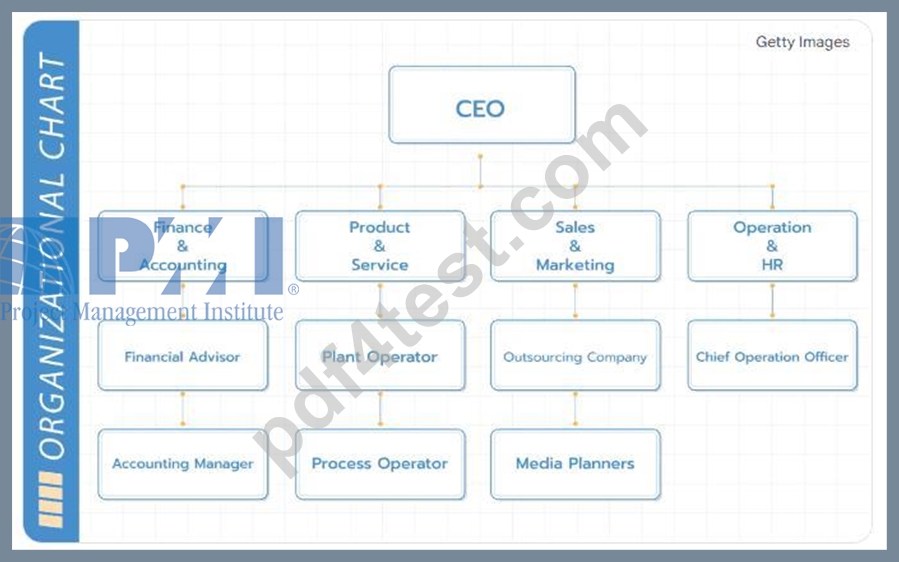
Choice A, B, and D are incorrect because they use non-standard terminology. While they sound plausible in a general business context, they are not the specific terms defined in the PMBOKGuide or the PMI Lexicon of Project Management Terms.
NEW QUESTION # 291
Match each dimension of the communications management plan to its corresponding focus.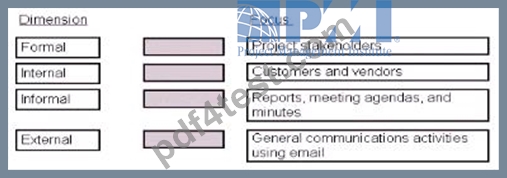
Answer:
Explanation: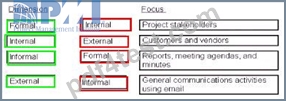
NEW QUESTION # 292
What is the name of a graphic display of project team members and their reporting relationships?
- A. Project organization chart
- B. Role dependencies chart
- C. Project team structure diagram
- D. Reporting flow diagram
Answer: A
Explanation:
Section: Volume C
NEW QUESTION # 293
A project manager is working with the team to prepare the estimates for various work items. The team needs to compare the relative sizing of the items. What should the project manager suggest the team use?
- A. Dependency planning
- B. Sprint planning
- C. Story point estimation
- D. Project task estimation
Answer: C
Explanation:
The correct technique is story point estimation because the team is comparing the relative size of work items rather than calculating exact hours, dates, or costs. Story points are commonly used in agile environments to estimate effort, complexity, uncertainty, and risk in relation to other backlog items. PMI's Lexicon defines a story point as "a unit used to estimate the relative level of effort needed to implement a user story." This directly matches the question's requirement to compare relative sizing. Project task estimation is broader and may apply to duration, effort, or cost in predictive planning, but it does not specifically indicate relative sizing. Dependency planning identifies sequencing relationships between work items, not size. Sprint planning is the event where the team selects and plans work for a sprint; it may include estimation discussions, but it is not itself the estimation method. In agile practice, relative estimation helps teams avoid false precision and create a shared understanding of work magnitude. References/topics: Agile Estimation, Story Points, Relative Sizing, User Stories, Adaptive Approaches.
NEW QUESTION # 294
Which of the following is a set of interrelated actions and activities performed to achieve a prespecified product, result, or service?
- A. Process
- B. Program
- C. Project
- D. Portfolio
Answer: A
Explanation:
Section: Volume D
NEW QUESTION # 295
What is the common factor among portfolios, programs, and projects, regardless of the hierarchy within an organization?
- A. Project manager
- B. Operations and performance
- C. Resources and stakeholders
- D. Subsidiary projects
Answer: C
Explanation:
According to the PMBOK Guide and the Standard for Portfolio Management, portfolios, programs, and projects are different ways of grouping and managing work to achieve organizational goals. While they differ in their specific objectives and life cycles, they share fundamental environmental and structural elements.
Resources and Stakeholders: Regardless of whether a manager is overseeing a single project, a group of related projects (program), or a strategic collection of work (portfolio), they must all contend with the management of resources (people, equipment, funding, and materials) and the engagement of stakeholders.
Resources: All levels of the hierarchy compete for or share the same limited organizational resource pool.
Stakeholders: Every level has individuals or groups who can influence or be influenced by the work.
Managing expectations and relationships is a constant requirement across all tiers.
Analysis of other options:
Operations and performance (Option B): While performance is measured at all levels, " Operations " are distinct from projects and programs. While portfolios can include operations, projects and programs are by definition temporary, whereas operations are ongoing.
Subsidiary projects (Option C): This is specific to programs and portfolios. A project does not typically contain " subsidiary projects " (it contains tasks, work packages, or activities).
Project manager (Option D): A portfolio is managed by a Portfolio Manager, and a program is managed by a Program Manager. While they are all management roles, the specific title of " Project Manager " does not apply to the oversight of the entire hierarchy.
Per PMI standards, the effective management of Resources and Stakeholders is the universal thread that ensures organizational alignment and successful value delivery across the entire PMO structure.
NEW QUESTION # 296
What type of planning is used where the work to be accomplished in the near term is planned in detail, while work in the future is planned at a higher level?
- A. Rolling wave planning
- B. Finish-to-start planning
- C. Short term planning
- D. Dependency determination
Answer: A
Explanation:
According to the PMBOKGuide, specifically within the Define Activities process of Project Schedule Management, the technique described is Rolling Wave Planning.
* Definition: Rolling wave planning is an iterative planning technique in which the work to be accomplished in the near term is planned in detail, while the work in the future is planned at a higher level.
* Application: It is a form of progressive elaboration applicable to work packages, planning packages, and release planning when using agile or waterfall methodologies. As the project progresses and more information becomes available, the " wave " rolls forward, and work that was previously planned at a high level (the future) is decomposed into detailed activities as it approaches the near-term horizon.
* Purpose: This approach allows the project team to start work on immediate tasks without waiting for every detail of the long-term project to be known, which is particularly useful in environments with high uncertainty or evolving requirements.
* Choice A (Finish-to-start planning) is a logical relationship used in sequence activities, not a planning approach for detail levels.
* Choice C (Short term planning) is a general business term but is not the specific PMI technical term for this progressive elaboration technique.
* Choice D (Dependency determination) refers to the process of identifying the relationship between activities (Mandatory, Discretionary, External, Internal), not the depth of the planning horizon.
NEW QUESTION # 297
Drag and Drop Question
Match each Project Cost Management process with its appropriate keyword.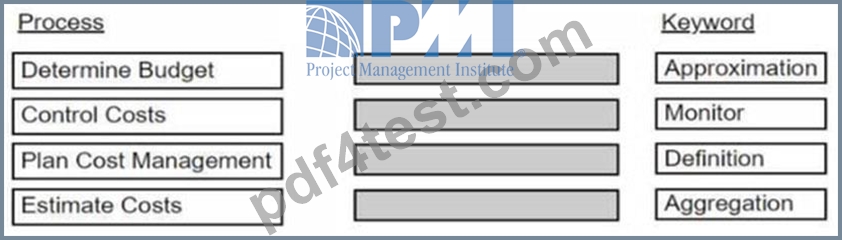
Answer:
Explanation: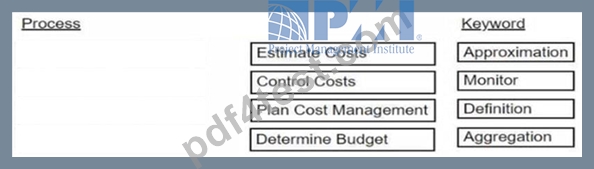
NEW QUESTION # 298
Which of the following response strategies are appropriate for negative risks or threats?
- A. Share, Accept, Transfer, or Mitigate
- B. Exploit, Enhance, Share, or Accept
- C. Avoid, Mitigate, Transfer, or Accept
- D. Mitigate, Share, Avoid, or Accept
Answer: C
NEW QUESTION # 299
Stakeholder identification and engagement should begin during what phase of the project?
- A. After the communications management plan is completed
- B. After the project management plan is completed
- C. As soon as the project charter has been approved
- D. After the stakeholder engagement plan is completed
Answer: C
Explanation:
According to the PMBOKGuide, the process of Identify Stakeholders belongs to the Initiating Process Group. This signifies that stakeholder identification and engagement must occur at the very beginning of the project life cycle.
* Timing of Identification: The project charter is the document that formally authorizes the existence of a project. Once the charter is approved, the project manager is assigned and must immediately begin identifying the people, groups, or organizations that could impact or be impacted by the project.
* Early Engagement: Engaging stakeholders early is critical for project success. It helps in uncovering requirements, identifying potential risks, and building the necessary support and buy-in before significant planning or execution occurs.
* Iterative Nature: While it starts as soon as the charter is approved, PMI emphasizes that stakeholder identification is an iterative process. It should be revisited throughout the project as new stakeholders emerge or the project environment changes.
Analysis of other options:
* A. After the project management plan is completed: This is much too late. Stakeholder requirements and expectations are essential inputs to the project management plan itself.
* B. After the stakeholder engagement plan is completed: This creates a logical paradox. You cannot create a plan for how to engage stakeholders until you have first identified who those stakeholders are.
* D. After the communications management plan is completed: Similar to the other planning options, communication requirements are derived from knowing who the stakeholders are. Identification must precede the creation of communication or engagement plans.
Per PMI standards, identifying and engaging stakeholders as early as possible ensures that their influence is channeled positively and that the project remains aligned with their needs from day one.
NEW QUESTION # 300
The following is a network diagram for a project.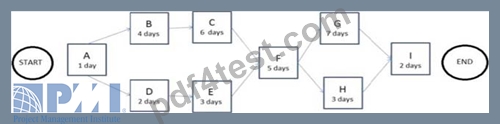
The free float for Activity H is how many days?
- A. 0
- B. 1
- C. 2
- D. 3
Answer: C
NEW QUESTION # 301
The project manager needs to obtain proposals on costs of supplies purchased from an external source. In order to conduct this in a fair and unbiased way, what should the project manager conduct?
- A. Stakeholder meeting
- B. Stakeholder conference
- C. Bidder conference
- D. Procurement conference
Answer: C
Explanation:
A Bidder Conference (also known as a Pre-Bid Conference) is a meeting held by the project manager with potential vendors or suppliers to ensure a fair and unbiased procurement process.
It allows:
- Vendors to clarify requirements before submitting proposals.
- The project manager to ensure transparency and prevent favoritism.
- All bidders to receive the same information, reducing misinterpretations.
NEW QUESTION # 302
Which index is the calculated projection of cost performance that must be achieved on the remaining work to meet a specified management goal?
- A. Estimate at completion
- B. Cost performance
- C. Schedule performance
- D. To-complete performance
Answer: D
Explanation:
According to the PMBOKGuide, the To-Complete Performance Index (TCPI) is a measure of the cost performance that is required to be achieved with the remaining resources in order to meet a specified management goal, such as the Budget at Completion (BAC) or the Estimate at Completion (EAC).
* The Concept: While the Cost Performance Index (CPI) tells you how efficiently you have worked so far, the TCPI tells you how efficiently you must work from this point forward. It represents the " efficiency required " to get the project back on track or to finish within a revised budget.
* The Formulas:
* To finish within the original budget (BAC): $TCPI = (BAC - EV) / (BAC - AC)$
* To finish within a newly calculated estimate (EAC): $TCPI = (BAC - EV) / (EAC - AC)$
* Interpreting the Result:
* TCPI > 1.0: The remaining work must be performed more efficiently than originally planned to stay within budget. This usually happens when the project is currently over budget.
* TCPI < 1.0: The remaining work can be performed less efficiently than originally planned while still meeting the budget goal.
* TCPI = 1.0: The remaining work must be performed exactly at the planned rate.
Analysis of Other Options:
* A. Estimate at completion (EAC): This is the expected total cost for the project when all work is finished. It is a forecast of the final cost, not an efficiency index for remaining work.
* B. Cost performance (CPI): This is a measure of the cost efficiency of budgeted resources expressed as the ratio of earned value to actual cost ($EV / AC$). It reflects past performance.
* C. Schedule performance (SPI): This is a measure of schedule efficiency expressed as the ratio of earned value to planned value ($EV / PV$). It does not address cost projections for remaining work.
NEW QUESTION # 303
After an internal deliverable review session with the team, the project manager identifies some issues that need to be fixed before submitting the deliverable for formal approval. The project manager will need to manage the additional costs and time for the required rework.
How would the project manager define these extra costs?
- A. Cost of conformance
- B. Cost of nonconformance
- C. Appraisal costs
- D. Management reserves
Answer: C
NEW QUESTION # 304
Following a project planning meeting with the team, a few team members approach the project manager to follow up on actions required. How can the project manager assess the effectiveness of the meeting?
- A. Ask the team members to provide feedback for meetings in the phase retrospective.
- B. Consult the communications management plan to determine the success criteria for meetings.
- C. Review the actions from the meeting with each of the project team members to ensure their understanding.
- D. Send the meeting minutes to all team members to verify that the required information is readily available.
Answer: C
Explanation:
According to the PMBOKGuide and the Standard for Project Management, effective communication is not just about the distribution of information, but the confirmation of understanding. In the Monitor Communications process, the project manager must ensure that the communication artifacts (like meeting outcomes) have achieved their intended purpose.
* Why Choice C is correct:
* Closing the Feedback Loop: The true measure of a meeting ' s effectiveness is whether the participants can act on the decisions made. By reviewing the actions with team members, the PM identifies gaps in understanding or misinterpretations that occurred during the meeting.
* Interpersonal and Team Skills: This approach utilizes active listening and feedback, which are core power skills. It allows the PM to verify that " noise " did not interfere with the message and that the team is aligned on the path forward.
* Immediate Correction: Unlike waiting for a retrospective, this provides immediate insight into whether the planning session was successful or if the team is still confused about their responsibilities.
Analysis of other options:
* A (Send the meeting minutes): Sending minutes is a standard administrative task (distribution), but it is passive. Simply having information " readily available " does not mean it was understood or that the meeting was effective in influencing behavior.
* B (Wait for the phase retrospective): While retrospectives are excellent for process improvement, waiting until the end of a phase is too late to assess a specific planning meeting ' s effectiveness. The project may have already suffered from misalignment by then.
* D (Consult the communications management plan): The plan defines how meetings should be conducted and what the criteria are, but it is a static document. Consulting it doesn ' t tell you how well a specific meeting actually went in practice.
Key Concept: The Project Management Institute (PMI) emphasizes that " Communication = Understanding. " Choice C is the most proactive and direct way to assess if the meeting ' s objectives were met by checking the
" output " (team understanding) against the " input " (the meeting content).
NEW QUESTION # 305
What is the most accurate rough order of magnitude (ROM)?
- A. In the Closing phase, the estimate is in the range of +/- 15%.
- B. In the Initiation phase, the estimate is in the range of +/- 50%.
- C. In the Planning phase, the estimate is in the range of +/- 50%.
- D. In the Monitoring and Controlling phase, the estimate is in the range of +/- 15%.
Answer: B
NEW QUESTION # 306
......
Prepare for the Actual CAPM CAPM Exam Practice Materials Collection: https://pass4sure.pdf4test.com/CAPM-actual-dumps.html
